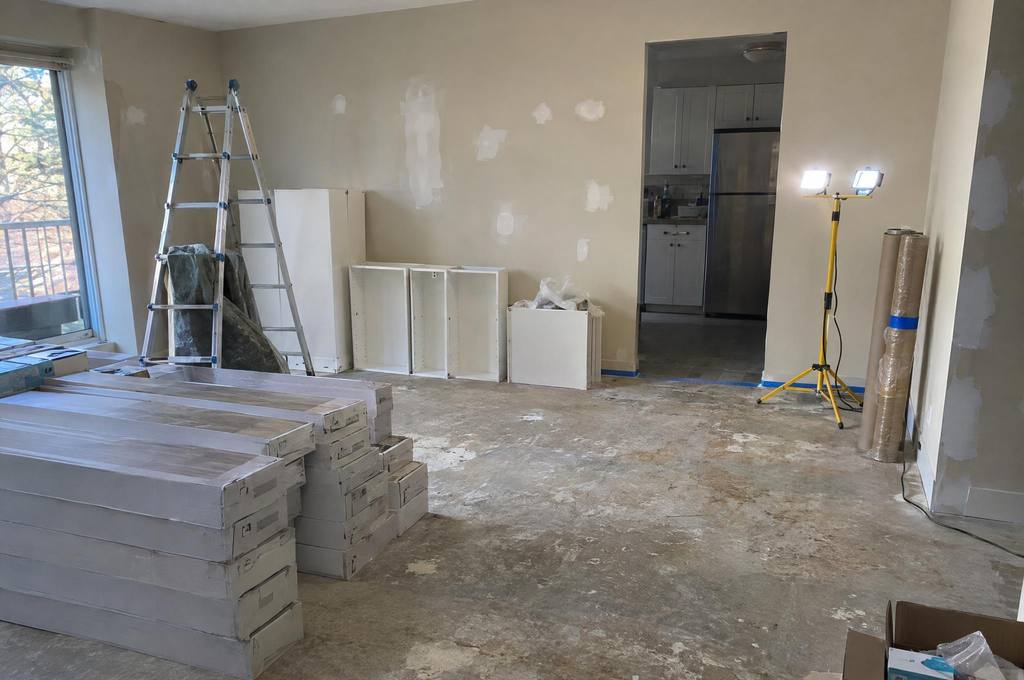
Renovation access and debris in North York
Plan deliveries, construction hours and renovation debris removal for a North York house or condo before the rooms are opened up.
The route in and the route out
A renovation needs a place for the new cabinets and a route for the old ones to leave.
In a house, that route can run through the hallway that is also being repaired.
In a condo, it includes the unit door, corridor, elevator and loading area.
Send the full route with the room list, including stairs or turns between the elevator and the outside door.
MRG agrees building access and protection before unit work starts, and debris removal belongs in the written renovation scope.
Tell us what will remain in the home and where incoming materials can wait without blocking the rooms people still need to use.
Toronto construction hours
Toronto prohibits clearly audible construction noise from 7 p.m. to 7 a.m. the next day, with the morning limit extended to 9 a.m. on Saturdays.
The prohibition also covers all day on Sundays and statutory holidays.
These are the City's stated construction limits, and any exemption must be confirmed separately.
A condo corporation can also set contractor hours, so the building's approved window belongs with the work plan.
Tile cutting, drilling and demolition have to fit the hours that apply to the job.
Loading and unloading have a separate section in the noise by-law and should not be treated as permission to keep renovating later.
Tell us the days and times management has approved before material deliveries and noisy work are scheduled.
Parking and a bin on public space
Say if the proposed truck space is on the property or on the street.
Toronto's traffic code includes a general three-hour parking limit and restrictions at driveways and fire hydrants.
Describe the available parking and nearby signs instead of assuming that a renovation vehicle can remain at the curb for the whole workday.
A commercial loading zone is for active loading or unloading, so it is not a substitute for daily parking.
When a renovation occupies the public right of way, Toronto requires a street occupation permit.
The City's examples include a disposal bin in the roadway.
Show whether the planned bin or material area lies on your property or extends onto the sidewalk or road, and identify that requirement before the work is booked.
Disposal of removed finishes
Toronto lists cabinets, countertops, doors, drywall, baseboards and tile among renovation materials it does not accept in oversized curbside collection.
These are common parts of a multi-room job, so removal cannot be left as an assumption after demolition.
The building's garbage room is also not an agreed destination unless the building has specifically arranged the appropriate disposal route.
Demolition, old-finish removal and disposal are part of a unit renovation when they are named in the agreement.
Tell us about old paint containers or unidentified material before it is mixed with the load.
Different materials need different handling and acceptance checks, and the City lists mixed loads of waste, recycling and prohibited materials as unacceptable at its transfer stations.
Source: City of Toronto, oversized items and renovation waste
Weighing and unloading renovation waste
The City lists Ingram at 50 Ingram Drive in North York and identifies clean drywall up to one tonne among its accepted materials.
That listing does not make every renovation material acceptable in the same load.
The transfer station rules contain prohibited materials, so the destination has to match what is being removed.
For Ingram's other accepted items, the published operating window runs from Monday at 6 a.m. to Saturday at 12:30 p.m., with a nightly pause from 11:30 p.m. to midnight.
Separate hours apply to household hazardous waste and electronics, and the site is closed on Sundays.
The City's depot process requires weighing the vehicle, declaring material and a deposit before unloading.
The driver unloads at the directed location and returns to the scales for the final weight.
Loads must arrive covered and secured, and unsafe vehicles or unsecured loads can be refused.
The removal schedule needs to leave enough room for the next stage of renovation and the material coming in.
Local sources
- City of Toronto, construction requirements
- Toronto Municipal Code, Chapter 591, Noise
- Toronto Municipal Code, Chapter 950, Traffic and Parking
- City of Toronto, street occupation permits
- City of Toronto, oversized items and renovation waste
- City of Toronto, depot locations and hours
- City of Toronto, transfer station rules and prohibited waste
- City of Toronto, waste drop-off process
- Condominium Authority of Ontario, condo renovations
Sources checked on 15 November 2026.
Services and access details
Questions about renovation access and debris
Which routes should be described for a multi-room renovation?
A renovation needs a place for the new cabinets and a route for the old ones to leave.
In a house, that route can run through the hallway that is also being repaired.
In a condo, it includes the unit door, corridor, elevator and loading area.
What Toronto construction hours affect interior work?
Toronto prohibits clearly audible construction noise from 7 p.m. to 7 a.m. the next day, with the morning limit extended to 9 a.m. on Saturdays.
The prohibition also covers all day on Sundays and statutory holidays.
These are the City's stated construction limits, and any exemption must be confirmed separately.
What needs checking before a renovation bin uses public space?
Say if the proposed truck space is on the property or on the street.
Toronto's traffic code includes a general three-hour parking limit and restrictions at driveways and fire hydrants.
Describe the available parking and nearby signs instead of assuming that a renovation vehicle can remain at the curb for the whole workday.
Tell us which rooms are changing
Send the room list, the address and what you want to keep for a written renovation scope.